As the market’s focus on population health intensifies, panel management is evolving as a core component of successful care delivery. In response, organizations are looking to improve quality, optimize care team operations, and strengthen the patient and primary care physician/advanced practice provider (APP) relationships.
A patient panel is generally defined as the count of unique living patients served by a provider (physician, APP, or provider group) within a distinct period of time (e.g., 18 to 24 months). The count may be further defined by risk-based adjustments such as patient age, gender, and acuity. Panel size provides insight into the volume and acuity of patients managed by a provider and may serve as a measure of patient access (i.e., how quickly and easily a new or existing patient can be seen by a provider).
The Centers for Medicare and Medicaid Services (CMS) and commercial payers are increasing their focus on risk-based contracts and value-based reimbursement. To achieve shared savings, CMS Alternative Payment Models, such as Primary Care First, Direct Contracting, and Accountable Care Organization REACH, are requiring organizations to evaluate panel management and patient care delivery. Impacting these assessments are the role of APPs, accurate documentation and coding, and alignment of provider compensation structures. Health care organizations continue to evolve in these areas as they enhance population health strategies.
The Role of the Advanced Practice Provider
Optimizing APP utilization is one strategy organizations are pursuing to maximize value-based reimbursement. Survey data indicate a 25% increase in employed APP staff between 2018 and 2020 -which significantly outpaced employed physician growth of 3.4% within the same period.1 Whether APPs independently manage a patient panel or share a physician panel, a collaborative approach may improve patient access, outcomes and satisfaction, and help to alleviate provider burnout.
SullivanCotter recently partnered with a multi-hospital health system seeking to maximize APP utilization and improve care team collaboration. The project began with a current state assessment to evaluate workflow, care team operations and infrastructure. Identified areas of improvement included APP productivity, risk-stratification (appropriate patient triage and assignment), performance measurement and reporting, and care management functions.
Engaging physicians and APPs in a collaborative process, the organization implemented the following actions to improve care delivery:
- Evaluated and restructured the APP role to allow each to function as a provider working at top of license
- Revised patient scheduling templates to increase APP productivity
- Defined a risk-stratification process to assign patients to the right care team member
- Enhanced measurement and reporting capabilities by transitioning manual processes to interactive dashboards and enabling physicians and APPs to track productivity and value-based performance
- Created a nurse-led care team and collaborative partnerships to improve care management functions
As a result, the organization achieved the following results:
- 15% increase in APP productivity
- 40% increase in Medicare Annual Wellness Visits
- Double-digit increases in Hierarchical Condition Categories (HCC) values and documentation rates
- Patient satisfaction survey scores indicating better and more comprehensive care
- Provider feedback demonstrating greater team collaboration and improved connection to patients
The Importance of Coding and Documentation
Accurate coding and documentation impact both risk-adjusted panel size and panel management. Properly documenting diagnosis codes with assigned HCC values enables precise capture of patient complexity, identification of the true cost of care, and maximized reimbursement.
The conceptual example below illustrates the risk-adjusted revenue and per member per year reimbursement associated with limited versus comprehensive HCC documentation.
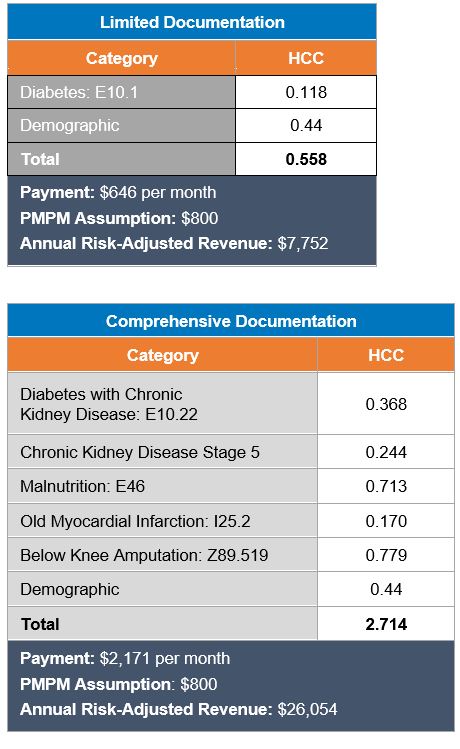
Comprehensive documentation also supports efficient risk-stratification to help ensure patients see the most appropriate care team member. For example, an older patient with multiple chronic conditions and excessive emergency room visits would be assigned to a physician while a patient managing flu symptoms would be assigned to a nurse. Accurate and efficient HCC coding supports the collaborative care team function and positively impacts the overall success of an institution’s population health strategy.
Provider Compensation Structure Alignment with Population Health Strategies
Given the impact on both revenue and patient care, how can health systems accentuate the importance of panel management? In recent years, many organizations have been redesigning physician and APP compensation plans to more effectively support population heath management, teamwork and collaboration.
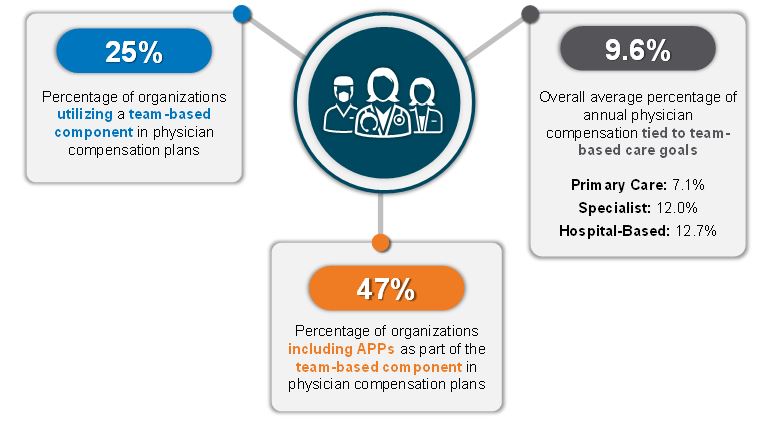
It follows that team-based incentives are an emerging discussion topic among provider compensation committees. According to SullivanCotter’s 2021 Physician Compensation and Productivity Survey Report, approximately 25% ofrespondents utilize team-based compensation elements in physician compensation structures. 2 Of those, 47% include APPs within the team-based incentive. 2
Progressive organizations are implementing panel size into their primary care compensation models. SullivanCotter’s 2022 Large Clinic™ Physician Compensation and Productivity Survey Report shows that 43% of respondents (up 13% from 2019) utilize panel size metrics in primary care compensation plans – representing approximately 15% of a physician’s total clinical compensation. 3
Additional SullivanCotter research related to panel management indicates that:
- The percentage of revenue tied to value-based contracts and capitated payments is expected to increase 67% over the coming years4
- 77% of participants identified panel management as either “important” or “extremely important” to organizational operations and strategic initiatives4
- Only 45% of administrators believe their organizations are calculating panel size with a strong degree of accuracy4
- Only 30% of physicians believe their organizations can report panel size with a strong degree of accuracy4
Conclusion
As health care organizations seek to improve the quality of care provided to the populations they serve, developing panel management strategies is a critical cornerstone. Evaluating and understanding short and long-term reimbursement risk, maximizing the roles of APPs and other care team members, enhancing population health metric measurement and reporting, educating providers on appropriate coding and documentation, and developing strategically- aligned compensation structures will support the achievement of system-wide population health goals.
Authors:
Courtney Dutton, Managing Principal
Paula Friedrich, Principal
SOURCES
- SullivanCotter 2022 Advanced Practice Provider Compensation and Productivity Survey
- SullivanCotter 2021 Physician Compensation and Productivity Survey
- SullivanCotter 2022 Large Clinic™ Physician Compensation and Productivity Survey
- SullivanCotter 2020 Patient Panel Management Survey: Large Clinic™ Group