Surprisingly, calculating the return on investment (ROI) of physician compensation technology is not as difficult as many organizations that employ medical providers might expect. The benefits of physician compensation technology are generally well-defined, many can be tracked, and it’s straight-forward to translate operational and process improvements into actual dollars.
Physician compensation software typically works by minimizing the manual processes of administering, measuring, and managing the performance of physician compensation plans. It automates the calculation and adjudication of physician compensation and provides real-time feedback to both administrators and physicians.
As a result, it fosters transparency, accuracy, and efficiency all at once, with potentially profound impacts on payroll, physician relationships (including turnover and retention), and even patient experience.
But how can we quantify those impacts?
1: Reducing error rates.
If provider compensation is calculated via Microsoft Excel or some other spreadsheet or database program, the compensation process will be very susceptible to error.
That’s because manual intervention, disconnected processes, and disparate systems can often lead to incorrect information and miscalculations. When staff have to input data points by hand, inevitably some will be incorrect. As the sheer number of contract types and variables grows unmanageable, some elements will be increasingly missed or lost.
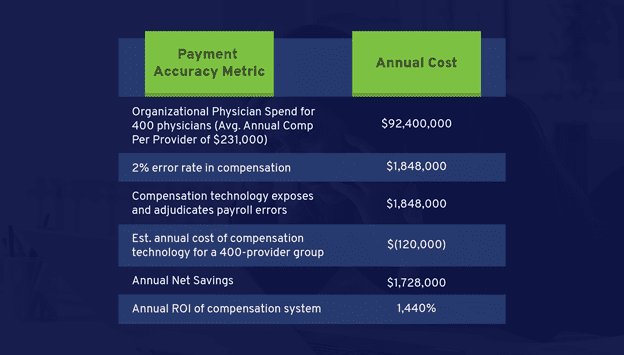
Spreadsheets are also simply notorious for errors. As many as 88% of spreadsheets contain errors, with error rates ranging between 1.2% and 2.5%. At scale, even incremental error rates can turn into huge dollar amounts. As Sae Evans, a CPA with accounting and HR advisory group Warren Averett, told Birmingham Medical News, “When it comes to billing, little oversights can make a huge difference over time and can significantly impact physician compensation.”
Compensation management technology will both store the provider’s contract and complete any calculations, referencing the discrete pay element-level data listed within the agreement. That way, the technology can maximize the accuracy of each group’s calculations and automate compensation activity.
Additionally, automated triggers and alerts for specific payment details – including payment types, frequency, thresholds, amounts, and adjudication of calculation against the payroll system should produce a reduction in payroll errors by a minimum of 2%.
That reduction, in turn, can yield substantial return on investment by itself.
2: Reducing physician turnover and increasing retention.
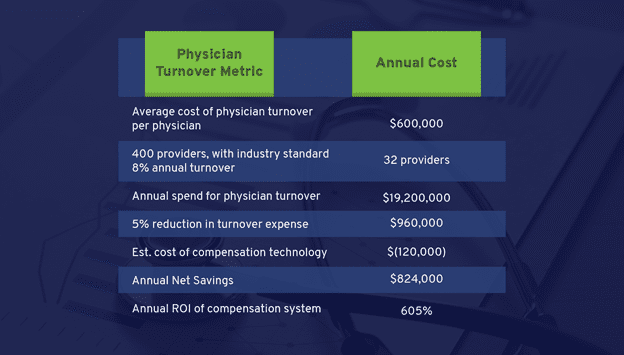
The median turnover for care providers in adult groups is 8% (but can go as high as 11.5% in certain areas), with costs that range anywhere from hundreds of thousands of dollars to over a million dollars per provider. As a result, a medical group with a few hundred providers likely faces annual turnover costs in the millions, conservatively.
Turnover is obviously a complex problem with many contributing factors, but one of the most common issues comes down to a lack of transparency that fosters a “culture of distrust” between providers and administrators.
Simply put, single-source compensation management technology reduces distrust. It brings clarity, manages expectations, and facilitates communication. After all, health systems want to communicate clearly and accurately just as much as physicians do. They simply don’t have the capability to do so without a single-source technology solution in place. With such a technology solution, they can provide a single source of truth where all KPIs can reside and be reported on and communicated out to everybody in the group, providing total clarity and transparency and facilitating trust.
In turn, physician satisfaction and relationships can improve. That translates into quantifiable ROI. The table below demonstrates the expected cost savings for a medical group with just over 400 physicians, with a conservative estimate of 5% reduction in total turnover expense.
3: Reducing manual labor.
Process automation – another function of physician compensation technology – also reduces reliance on costly manual labor. That can promote efficiency gains against the direct cost of compensation analysts that translates into time saved.
These savings can be significant; the University of Missouri Health system integrated its medical devices to automatically collect and capture patient data after observing their staff’s inefficient data entry processes. As a result, they realized a total time savings of 36,051 hours per year.
The labor savings from physician compensation software won’t be quite as dramatic as that, but it will still be significant. In our experience, approximately one full-time equivalent employee (FTE) is required for every 100 physicians, on average. If the organization can reduce the man-hours required, they can redeploy valuable staff members to more productive initiatives. Thus, the ultimate ROI will depend on how effectively compensation analysts redirect their time into other activities, but the potential is there for significant gains.
The ROI is real for physician compensation management technology.
The returns that your organization will realize from any technology implementation will be unique to you. It depends entirely on your goals and which KPIs you monitor. Your needs and situation will drive the benefits you experience. Indeed, even if your unique situation causes the calculations to differ from those presented in this paper – which are all based on generalized industry average data – one thing should be clear by now: the ROI of a physician compensation solution is both multifaceted and multilayered. It comes from many different directions; and, given the high costs involved, even incremental improvements can yield clearly measurable rewards.